Digital economy refers to an economy that based on producing by an electronic business and trade electronic goods and services through electronic commerce, therefore, digital economy is also known as Internet economy. ‘The world is ushering in a new era and new opportunities, the digital economy will reshape the world economy and the world economy will have a new model. Not only China, but the world is entering a new era.’ This is the evaluation of digital economy by Alibaba Group CEO Ma Yun. That is to say, digital economy changes the structure of production and labor in most of the jobs, and breaks the traditional management and work pattern. Actually, I will discuss the impact of digital economy for the travel agent and the development prospects.

When I was a child, my parents always took me to travel by joining in the local tour with lots of strangers, and the travel agent would arrange all the itineraries for you, such as transportation, accommodation, attraction and so on. And we usually communicate with the intermediary by face-to-face or by phone. Actually, tourism organizations are controlled by travel agencies, because they have more information about the travel destination and travelers have limited access to travel information in the age when the Internet was not popular. Therefore, due to the asymmetric information, travel agency is the first choice when we want to travel for a long time.
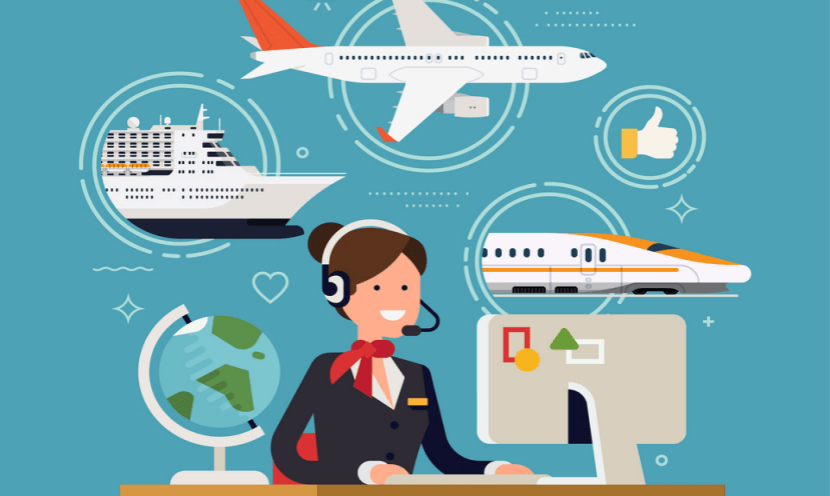

However, I prefer to choose the self-guided tour in the last few years, because the way of travel has changed along with the technology of the digital age and the ubiquity of mobile devices. At first, people fought that they can get more tourism information, products and services from all over the world through the Internet, so they want to make a travel plan by themselves without an intermediary. Actually, this trend brings crisis and challenge to tourism agents. There are lots of self- booking applications and websites that appear on the internet, such as Airbnb, Skyscanner, Uber and so on.
These products of the digital economy are becoming more and more popular because they can complete the search and trade of various tourism products without leaving the sofa because of simple in operation. Therefore, there are increasing people who think that the function of the traditional travel agent is getting smaller and smaller, so they want travel disintermediation which means reducing some middlemen as soon as possible and help customers get related tourism services and commodities directly. This makes the traditional travel agency need to be transformed into the online tourism agency (OTA) to adapt to the trend of the times.
However, with the popularity of Internet, self booking applications and websites have no access restriction for travelers which caused the situation of information overload for them.

Actually, People do not have much time and patience to browse all the travel information and make a perfect travel plan. They like to make a travel decision by comparing price and evaluation on one platform instead of visiting dozens of websites. Under these circumstances, tourism agent is not the middlemen, they are the main man. Therefore, tourism agency back on to the market after transformation because OTA has more extensive transmission of line information, and interactive communication is more convenient for customers to consult and order which provide more one-stop shops for travelers.
In addition, OTA offer staff service which is tourism agents and they can do something that self-booking tools can not do which is looking for experience in travel because it is an abstract requirement and can not be calculated by data. However, tourism agents would design a tailored trip for travelers to rely on their long years of work experience. That is to say, they would design your journey through your expected travel experience instead of some local fixed routes so that you can get the special tourist experience and cultural experience you want during your travel.
General speaking, the digital economy brought tourism agents not only opportunities and likelihoods in the future, but also risks and challenges. On the one hand, many professions are intelligentized including the tourism agent in the data age, ‘Ctrip’ application is a good example. There are lots of travel routes, hotels, transportation recommend to travelers, most services are replaced by computers because of efficiency. So many travel agents are facing unemployment. On the other hand, disintermediation is unrealistic in the future life. The biggest advantage of Tourism agent is personalized and humanized service. Travelers almost can keep in touch with the tourism agent all over the world and they would provide continuous and mobile help.

Tourism agencies could use the private relationship with suppliers like hotels and airlines to provide a better travel experience for travelers. In addition, tourism agent can use digital analysis deal with customer information so that they can not only not only improve efficiency, but also provide personalized services. All in all, some of tourism agent‘s jobs can not be replaced by computers, tourism agents are not only act as an online agent but also an experienced provider.
Reference
1.The Disintermediation of Travel | TTS. (2020). Retrieved 12 February 2020, from https://www.tts.com/blog/the-disintermediation-of-travel/
2.https://blog.locomote.com/the-future-of-the-travel-agency-industry
3.What is online travel agency and how does it work?. (2020). Retrieved 12 February 2020, from https://youtu.be/VbrOPs9q_-I
 Guoxiangdan
Hello Xiangdan
Thank for you let me further think about the changes in tourism agencies in the background of the digital economy. Generally, we only consider the negative impact on traditional travel agencies, as an increasing number of people like booking their travels online; however, if agencies would like to combine selling in-store with online, it would be a great opportunity for them. My friend work in Wonder&Tour in Nanjing, China. There are only 4 people working in the branch store; however, the travel agency runs well because most customers are from marketing online. Moreover, I really like the video that you shared about the advantages of OTA. It makes me consider the change in recruitment requirements for OTAs. They may need more employees who (1) are good at marketing to corporate with more airlines, hotels and attractions and communicate with consumers; (2) have professional computer skills to maintain and update the booking platform and analyse the characters of each tourist; (3) study in tourism management to design personalised service expanding niche markets. How do you think about?
LikeLike
This is an interesting article. As my major also is international tourism management, I can feel exactly what the author thinks. In this industry, the digital trend brought both positive and negative effects from my point of view. Except for OTA, there are other digital technologies that can make progress on tourism like VR and AI. These new things also would reduce the requirement of human resources by avoiding high salary and training fees and cause unemployment of tour guides or service staff as mentioned. As a tourist, I would like to choose some online digital services during making decisions or my trip, but I prefer to communicate with a real person instead of only robots. At the same time, some tourists might need some personal design services which can not be finished by digital technologies. The author’s opinion is very comprehensive and I really like this discussion.
LikeLike
This article is a very realistic description of how tour groups have changed over the last decade due to digital media and Apps. I also completely agree with the article that some travel agents still cannot be completely replaced by computers. With regard to the increasing tendency of people to use mobile phones, apps and official websites to make their own travel plans, I think that it has indeed brought great convenience to consumers. However, will these websites and Apps keep their customers’ information completely secret? Could it be stolen? Or secondary propagation? That is what I am worried about, and that’s probably what any industry in the digital media age might do to customers. However, people will still choose more convenient and convenient methods. After all, it is a small probability that privacy is not protected. I also believe that the police will pay more and more attention to this issue and take appropriate measures.
LikeLike
Hello, Xiangdan
This blog let me realise the changes of traditional travel agencies in the digital era. With the development of the Internet, people are more willing to search travel information directly from the Internet and book accommodation and tickets from travel applications. This has led to a shift from traditional travel agencies to online tourism agency. However, I think traditional travel agencies are not only facing challenges online, but also their physical stores are threatened by these travel apps. For example, the famous travel app Ctrip is now opening a large number of physical stores in China, which means that traditional travel agencies are also under great threat offline.In addition, I agree with you that it is impossible for the intermediate to be completely replaced by those applications. These travel apps also have their disadvantages, as online data may be falsified. For example, a well-known Chinese travel website, hornet’s nest, has been exposed as a source of fake data and online reviews, and it is often difficult for consumers to know whether the data is true or false. I think traditional travel agencies also need to pay attention to this problem in the transformation.
LikeLike
It is undeniable that e-commerce has brought great changes to the tourism industry. Most of the OTAs now serve tourists who are travelling on their own. Even with group tours, they are also one-day tours, which are completely different from previous group tours. Personally, I prefer individual tour. Firstly is because the time for group tours is too rushed. Tourists often arrive at a place and take a photo to prove that they have been there, and then leave with the guide. The second reason is that tourists may not all like the places specified in the group tour, but even if the tourists do not like them, they cannot leave the tour guide to visit other places, which gives the tourists a lot of restrictions, although I understand that tour guides are rich in experience and know where is the best place should we visit, but still.
On the one hand, de-intermediation can indeed save tourists money, but as the author said in the article, the personal relationship between the intermediary and the supplier can bring many conveniences to tourists. Everyone knows that Iceland’s Blue Lake Hot Springs are very famous. If you go by yourself, it is difficult to make an appointment. If you are with a group, you can take the VIP channel and take the lead. Another important point is that if it is a group tour, the timetable is generally set by the tour guide. We don’t need to worry about whether we will catch up or change the plan because of an emergency. This is also a great benefit of the tour guide. I also agree Should not go to the agency, after all, to go to the agency is only a personal choice, people still have the right to choose whether to travel with the group or free.
LikeLike
Like the travel industry, many others are also being disrupted by sharing economy digital business models that cut out the intermediary and bridge the gap directly with the consumer. Airbnb and Uber, like you have mentioned are great examples of sharing economies.
LikeLike